Why Modern Startups Need Growth Systems -- Not Just Marketing Agencies
Feb 10, 2026
VMPL
New Delhi [India], February 10: With the ever-increasing competition and constantly rising customer acquisition costs, more and more startups are reconsidering the concept of growth construction. Instead of escalating the irrelevant campaigns and channel-oriented strategies, founders are shifting towards a system-driven model of expansion - that is, one that revolves around performances, rather than efforts.
Regardless of unprecedented access to marketing talent, tools, and platforms, scale remains a primary issue that many startups have to wrestle with. The problem, the experts believe, is not a shortage of these efforts or their implementation. It's fragmentation.
Over the past decades, expansion has been fragmented into professional tasks. Performance agencies concentrate on advertisements. SEO teams chase rankings. On social media, the content calendars are run by social media agencies. Other pages get constructed as landing pages, and they have a separate analytics in dashboards. Both works could do great separately, yet when combined, development is erratic.
With a fragmented setup, agencies have the incentive to maximise what they are contracted to do (clicks, impressions, traffic or engagement). Founders, on the other hand, are responsible for results: growth in revenues, predictability, and momentum in the long term. In a world where there is no single owner of the growth system end-to-end, founders themselves will be the default integrators, understanding what to do between different reports, what conflicting metrics are, and the ways to create sense out of noise.
The outcome is a paradox many startups know to be the case: everywhere they are executed, but nowhere is it clear.
Growth Was Never Meant to Be Managed in Silos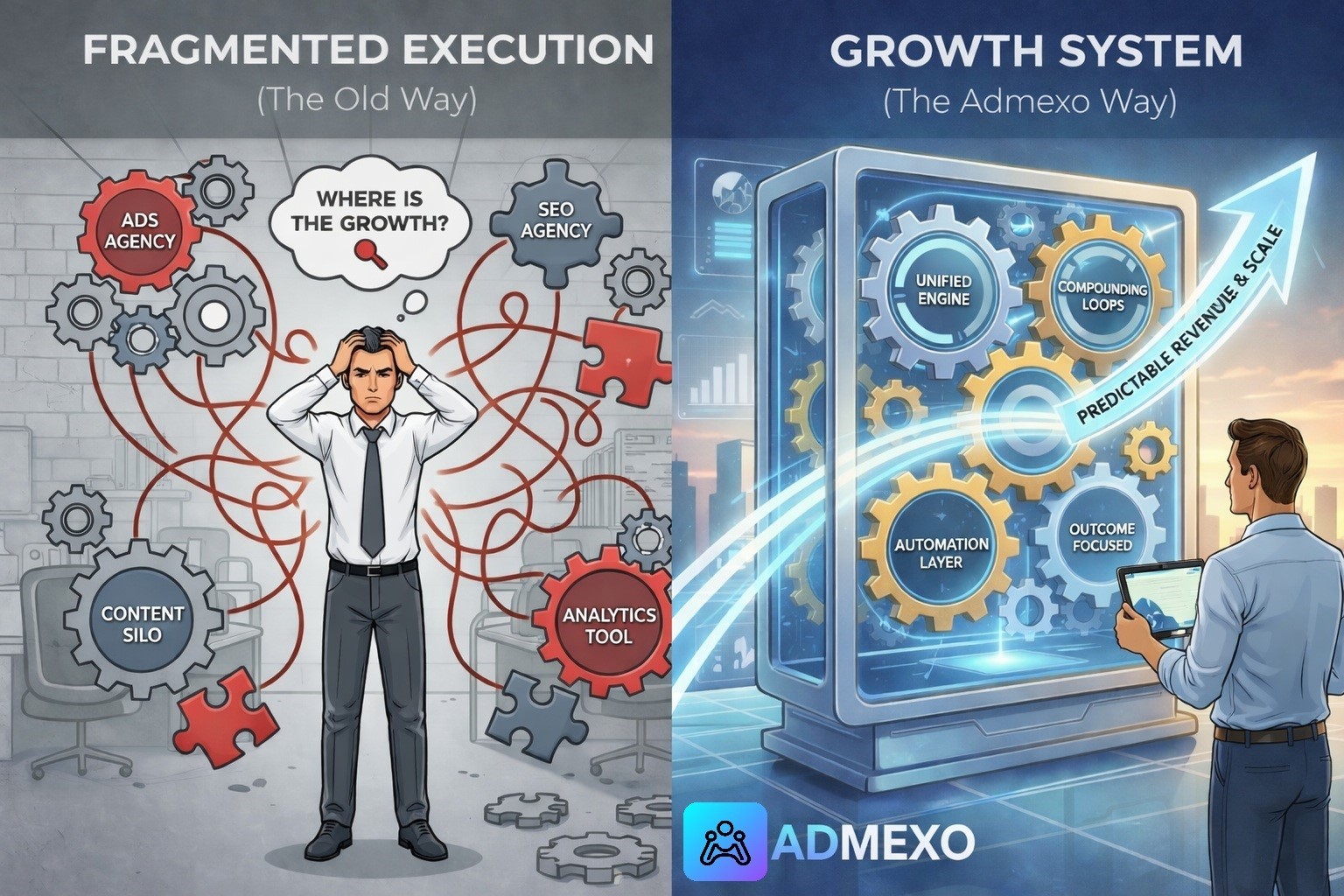
The contemporary growth can be perceived as a decision between the channel, paid advertisements, SEO, content or affiliates. However, channels are distribution mechanisms and not a strategy. The common approach of treating them as sheer levers does not capture the upstream forces, which are the actual determinants of scale.
Real growth begins with system design:
- How users enter the funnel
- What convinces them to stay and engage
- Where friction prevents conversion
- What compounds over time
When growth is formulated as a system, channels cease to compete over budgets but end up supporting each other. Content is informed by insights created by paid media. SEO enhances intent in the middle part of a funnel. Funnel optimisation enhances conversion efficiency on all sources of acquisition. Automation eliminates blocks that delay the process of learning and implementation. The result is not only improved performance, but it is also leverage.
Why Automation and AI Are Becoming Non-Negotiable?
The more complex the stacks of marketing, the more the operational drag. Founders are also found consuming time reviewing dashboards rather than making decisions. Teams waste hours in manual optimizations which do little to advance strategy.
This is the place where automation and AI are taking root as a base infrastructure- not a fad.
Properly, automation will eliminate noise in reporting, accelerate the decision loop, remove repetitive execution, and provide a signal rather than superficial measures. That is not to displace marketers, but simply to eliminate friction to allow strategy to dominate its execution, as opposed to incessantly pursuing that strategy.
A New Model for Growth Partnership
It is this change in thought that saw the development of AdMexo which is a growth partner but based on a single core idea; growth can no longer be provided as a series of services but rather as a system. AdMexo does not present performance marketing, funnels, SEO, affiliates, and automation as various line items, but rather combines them into one engine of growth focused on results. All of the components are oriented to support one another with the full system owned and not separate deliverables.
The founders cease to deal with vendors, and they begin to non-specifically scale systems when growth is constructed this fashion.
What Founders Should Look for in 2026 and Beyond?
As markets become more competitive, founders evaluating growth partners are encouraged to ask deeper questions:
- Who owns the entire growth system end-to-end?
- How do channels connect back to the funnel and revenue?
- What continues to compound if spending stops tomorrow?
- Where is automation reducing dependency on manual work?
Unclear answers will only make growth continue to be costly and unpredictable, no matter how many campaigns are launched.
The Future Belongs to System Builders
Companies of the next generation are not going to win by doing more. They will be victorious, coming up with superior systems. Scattered growth will not perform well as attention becomes less and the cost of execution increases. Sustainable advantage in 2026 and beyond will be enjoyed by those who substitute campaign thinking with system design, which is creating growth engines capable of learning, growing by building and compounding over time.
About AdMexo
AdMexo is an integrated growth system company that aims at designing and operating integrated growth engines for modern startups. AdMexo assists such founders to grow predictably and compound due to a strategy-driven channel, funnel, or automation without the need to make their operations complicated.
(ADVERTORIAL DISCLAIMER: The above press release has been provided by VMPL. ANI will not be responsible in any way for the content of the same.)